
The first 90 seconds: how sound influences the perception of a place
Par Christophe · 6 August 2026
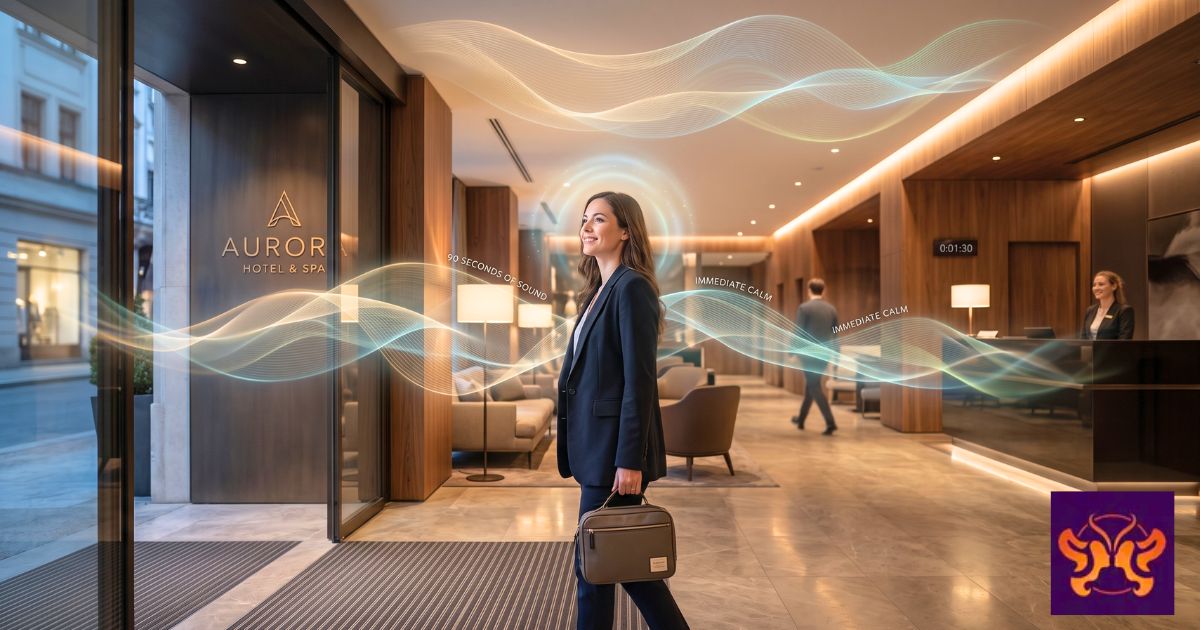
Sometimes it only takes a few seconds to form an impression of a place.
Even before speaking to anyone, before receiving a treatment or discovering a room, the guest has already begun to interpret what they feel. The light, the scent, the temperature, the flow, the silence, or the music make up a first impression.
In this first impression, sound plays a very specific role: it acts quickly, without requiring conscious attention.
You can close your eyes to a visual detail. It is much more difficult to ignore a sound ambiance.
Sound immediately conveys information
When someone enters a spa, a hotel, or a wellness space, they unconsciously look for cues.
Is it a quiet place?
Is it a premium place?
Is it a lively place?
Is it a well-managed place?
Is it a place where I can relax?
The music, or lack thereof, already answers these questions.
A sound ambiance that is too loud can give the impression of a less relaxing place.
Music that is too generic can weaken the establishment’s personality.
Complete silence can be pleasant in certain contexts, but it can also make small noises more noticeable: doors, conversations, footsteps, machines, notifications.
Sound, therefore, does not just serve to fill a void. It serves to provide a direction.
The first 90 seconds are a fragile zone
At the beginning of an experience, the guest is not yet settled in. They observe. They compare. They evaluate.
It is a sensitive moment.
If the sound ambiance is consistent, it eases the entry into the world of the place. If it is inconsistent, it creates doubt, however slight.
This doubt can be difficult to define. The guest will not necessarily say: “the music did not match the experience.” Instead, they might say that the place felt a bit cold, a bit noisy, a bit impersonal, or that they did not feel immediately relaxed.
Sound perception is often translated into other words.
The right sound reduces the effort of adapting
A wellness space should help the guest transition into a different state of mind.
They arrive with the pace of the outside world. The place must guide them toward a different pace.
A well-thought-out sound ambiance reduces this effort. It creates a framework. It signals to the body that it can slow down.
It is not just a question of volume. It is a matter of texture, stability, intensity, and consistency.
Calm but unstable music can still be tiring.
A discreet but well-constructed ambiance can be highly effective.
Sound does not need to be spectacular. It just needs to be right.
The entrance must match the promise
Every place promises something, even without saying it.
A spa promises relaxation.
A hotel promises a quality welcome.
A treatment space promises care.
A premium place promises mastery.
The sound ambiance must support this promise.
If the sound contradicts the positioning, the experience becomes less clear. If the sound confirms it, the guest understands more quickly where they are and what they can expect.
That is why the entrance of a place should not be treated as a simple transition area. It is the first chapter of the experience.
Conclusion
The first 90 seconds do not determine everything, but they guide a lot.
They give the guest their first reading of the place. They set an expectation. They can create trust or distance.
A professional sound ambiance makes this entrance more consistent, smoother, and clearer.
The best sound is not the one the guest notices immediately.
It is the one that makes them feel, effortlessly, that the place is well-managed.