
From the Spa to the Room: Creating Sound Continuity Without Standardizing the Experience
Par Christophe · 17 August 2026
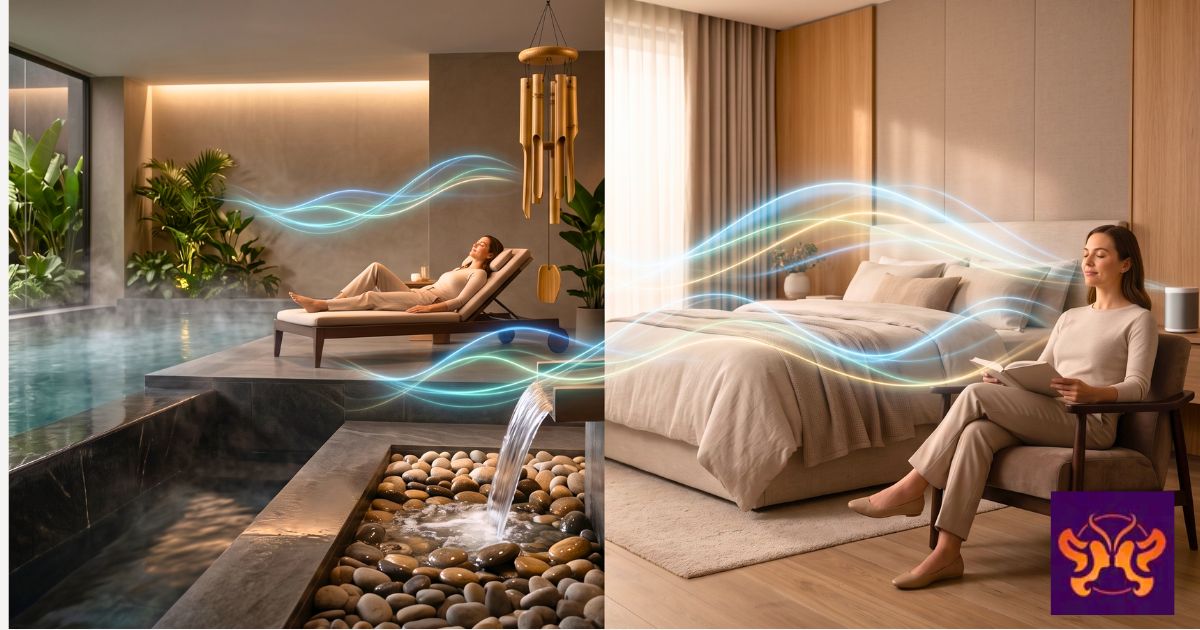
In a spa hotel, a guest does not experience a succession of isolated spaces.
They arrive, cross a lobby, perhaps wait a few minutes, go to a room, head down to the spa, pass through a changing room, enter a treatment room, and then return to a relaxation area. Each zone has its function. Each moment has its energy.
So, the question is not about playing the same sound environment everywhere.
The question is about creating continuity.
Continuity Does Not Mean Uniformity
A common mistake is to think that a coherent sound identity requires the exact same music in all areas.
In reality, this can make the experience feel flat.
A hotel lobby does not play the same role as a treatment room. A bedroom does not have the same sound needs as a relaxation area. A hallway does not require the same musical presence as a reception area.
Each zone must have an intention.
But these intentions must belong to the same universe.
Sound continuity is about making spaces feel connected, without making them interchangeable.
Each Space Has a Mission
To build a professional atmosphere, you must first understand the role of each zone.
The reception area must reassure and guide.
The lobby must establish a perception of quality.
The hallway must accompany the transition without creating a disruption.
The treatment room must allow for relaxation.
The bedroom must remain comfortable and personal.
The relaxation area must prolong the experience without restarting it too quickly.
If the music does not take these missions into account, it risks creating contradictions.
Too active an atmosphere in a relaxation area.
Too discreet a sound in a reception area.
A jarring break between the spa and the bedroom.
A generic playlist that erases the venue’s personality.
Guests do not always put these inconsistencies into words, but they feel them.
The Sound Signature as a Common Thread
A venue can have several atmospheres, but only one signature.
This signature can translate to a certain softness, sobriety, texture, a way of handling transitions, an absence of disruption, or a recognizable sound palette.
It doesn’t need to be obvious. It needs to be stable.
This is what allows the guest to move from one space to another without feeling like they are entering a completely different universe.
In a spa hotel, this continuity is particularly important. The guest does not just come for an isolated service. They come for an overall experience.
The Staff Shouldn’t Have to Decide Everything
Without a clear sound framework, each zone can become dependent on local decisions: one playlist at reception, another at the spa, a changed volume in a hallway, or a different atmosphere depending on who is working.
The result can be pleasant at times, but unstable.
Professional sound programming makes it possible to define a global logic and implement it easily.
It provides the staff with a framework, without adding a daily burden.
Conclusion
Creating sound continuity does not mean playing the same music everywhere.
It means building a journey.
Each space keeps its role, but the whole remains coherent. The guest moves from one moment to the next without disruption, with the feeling that the venue has been designed as a whole.
In a spa hotel, the sound atmosphere should not just accompany a room.
It must accompany the journey.