
Sound Therapy and Sleep
Par Christophe · 4 June 2026
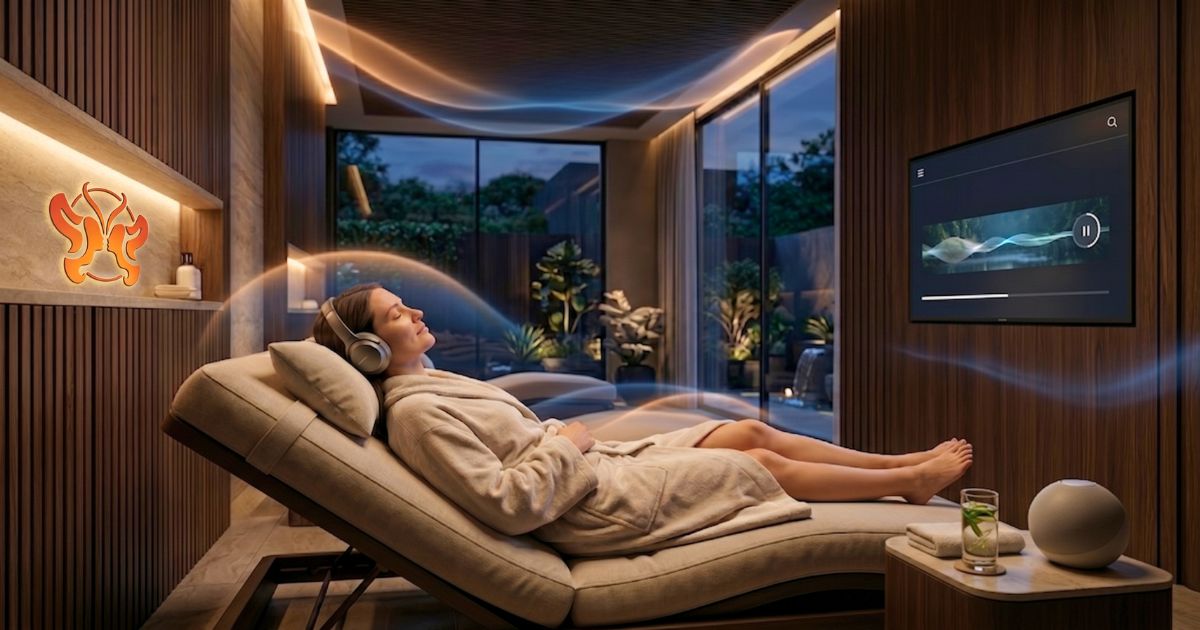
Why sound sometimes helps you sleep
Falling asleep is not about “doing something”, it is above all stopping keeping the brain on alert. Many people struggle with:
– mental rumination (spinning thoughts)
– bodily tension
– a breathing rate that is too high
Sound can help because it offers:
– an attentional anchor (listening instead of thinking)
– a timeframe (beginning / progression / end)
– sensory stability (a constant environment)
The 3 main families of “sleep-friendly” sounds
1) Soundscapes (rain, forest, waves, wind)
– Advantage: non-intrusive, easy to tolerate.
– Good for: light to moderate rumination.
2) Harmonic drones (long notes, bowls, pads)
– Advantage: enveloping sensation, slowing down.
– Good for: bodily restlessness / hypervigilance.
3) Guided voice + breathing
– Advantage: restructures attention, lowers breathing rate.
– Good for: bedtime anxiety.
The 14-day protocol (20 minutes)
Objective: test seriously, without kidding yourself.
Equipment
– Comfortable headphones or a soft speaker.
– Volume: low to medium (you should be able to speak without forcing your voice).
Session structure (20 min)
1. 2 min — “unlocking”
– sitting or lying down
– 3 slow breaths, without seeking performance
2. 6 min — guided breathing
– inhalation 4 s, exhalation 6 s (if comfortable)
– or simply exhaling slightly longer than inhaling
3. 10 min — sound bath / soundscape
– choose stable content, few surprises
4. 2 min — silence
– let it settle, do not “evaluate”
Measurement (ultra simple)
Each night, note:
– Stress (0–10) before
– Stress (0–10) after
– Estimated time to fall asleep
– Sleep quality (0–10) upon waking
Classic mistakes
– Changing content every night: confusing novelty with effectiveness.
– Volume too high: auditory fatigue and activation.
– Seeking the “right” result: the goal is to establish a ritual, not to succeed.
Adjustments according to your profile
– If you are sensitive to high pitches: favor deeper / duller sounds.
– If you have intrusive thoughts: add a guided voice at the beginning.
– If you wake up during the night: test a very gentle loop (and a sleep timer).
Safety checklist
– In case of tinnitus, hyperacusis, or migraines triggered by sound: use caution, low volume.
– If you have a history of epilepsy: avoid certain rhythmic patterns, seek medical advice.
Conclusion
The best content for sleep is not the one that “promises”, but the one that stabilizes your nervous system. A 14-day protocol, simply measured, will give you a concrete answer.
What to listen to on StarkStream (according to the site)
For a sleep ritual, you can choose from:
– Thematic Radios: Meditation, New Age, Asia, Balinese (regular ambiances, few surprises).
– Frequency Rooms Radios: Grounding 174 Hz, Nature Accord 432 Hz, Transformation 528 Hz (at low volume, for a fixed duration).
Tip: keep the same radio 3 nights in a row before drawing conclusions.